Solar Generator vs Plug-In Solar for an Apartment
A solar generator runs whatever you plug into it and keeps running in a blackout. A plug-in kit feeds your home's wiring and cuts your bill more. How to choose for an apartment.
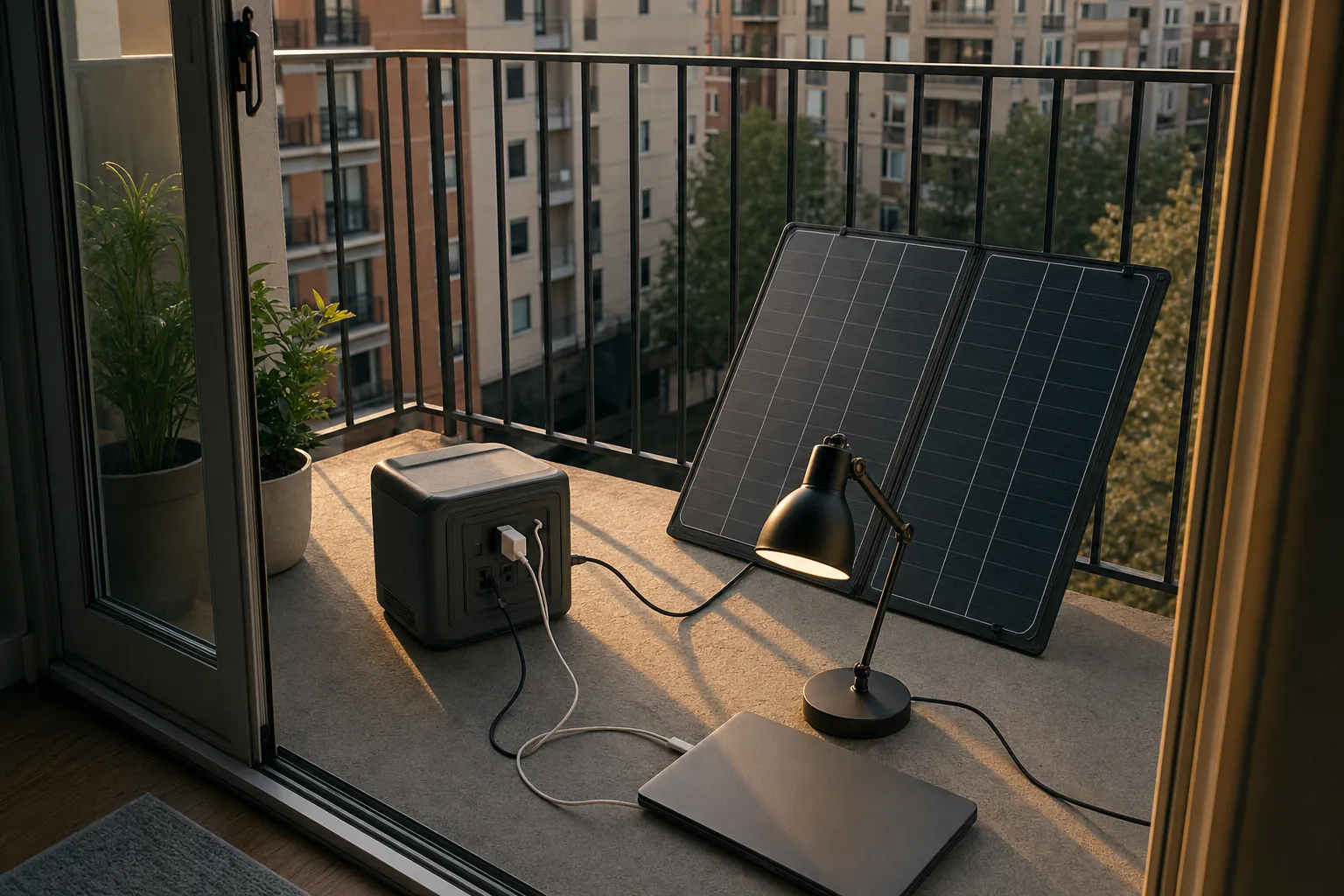
A solar generator is a battery box with outlets on it and a portable panel to charge it. You plug a lamp, a laptop or a fridge into the box. A plug-in solar kit has no box: its inverter plugs into a wall outlet and feeds your home's wiring, so everything already running uses the power first.
That difference sets the paperwork, the bill savings, and which one keeps working in a blackout.
Side by side
| Solar generator | Plug-in solar kit | |
|---|---|---|
| Connects to | The devices you plug into it | Your home's wiring, through an outlet |
| Stores power | Yes, in its battery | Only if the kit adds a battery |
| Works in a power outage | Yes, until the battery runs out | No, a grid-tied inverter shuts off |
| Cuts your bill | Only for what you plug into it | For whatever is running in your home |
| Utility agreement or state law | Not involved | Depends on your state |
| Certification to look for | UL 2743 (portable power packs) | UL 3700 or UL 1741 |
| Moves with you | Yes, and works off the balcony too | Yes |
How each one connects
Lawrence Berkeley National Laboratory researchers define plug-in solar and storage by "their ability to backfeed power into the home through an AC plug." That is what a plug-in kit does. The meter sees your home pulling less from the grid while the sun is up, and you don't have to change anything you own.
A solar generator doesn't backfeed. Power goes from the panel into the battery, and from the battery out through the generator's own outlets. Nothing reaches your walls. If you want the fridge on solar, you unplug it from the wall and plug it into the generator.
Never plug a generator's output into a wall outlet to reach the rest of the apartment. The Consumer Product Safety Commission calls this backfeeding and says it "presents an electrocution risk to utility workers and neighbors served by the same utility transformer." The warning is written for fuel generators. A battery generator's AC outlet puts the same power on the same wires.
Permission and paperwork
The state laws and utility rules on our state pages are about equipment that sends power into a home's wiring. LBNL researchers note that "ratepayers with the ability to export power must sign an interconnection agreement," and that utilities can deny one. A solar generator can't export, so it doesn't come into that process.
That makes a generator the option for a renter in a state that hasn't settled plug-in solar yet, or with a utility that won't approve it. Your lease, your HOA and your building can still limit what hangs off the balcony. The renter mounting guide covers that part, and it applies to both.
What each one saves
Energy savings come from kilowatt-hours you don't buy. Both options start from the same panel output. We model a panel hanging vertically on a railing, since that's where most apartment panels go.
A single 200 W panel facing south on a Los Angeles railing makes about 213 kWh a year in our model (PVGIS 5.3, 14% system losses). That's about 0.6 kWh on an average day. At California's average residential rate of 33.05 cents per kWh, it's worth about $70 a year, and only if every kWh replaces power you would have bought. That arithmetic is ours, from the figures behind our calculator.
A plug-in kit gets close to that ceiling without effort, because your fridge, router and standby loads use its power as it's made. A generator gets there only if you keep moving the right devices onto it, and a full battery with nothing plugged in saves nothing. Some power is also lost going into and out of the battery.
Batteries fill slowly from one panel. At 0.6 kWh a day, a 1,152 Wh generator takes about two average days of sun to charge from empty. Larger generators take proportionally longer, which is why they're sold with bigger panel bundles.
Power outages
A plug-in kit's inverter shuts off when the grid goes down. Inverters that meet UL 1741 do this on purpose, so they can't energize lines a utility crew is working on. A basic kit won't run anything during a blackout.
A generator keeps powering what's plugged into it, and the panel tops it up during the day. Small loads like a phone, a laptop, a router and LED lights are where a 1 kWh generator goes furthest. Before you count on it for a fridge, compare the fridge's rated daily use with the generator's capacity.
Safety and certification
For a plug-in kit, look for certification to UL 3700, the document written for plug-in solar, or at least an inverter certified to UL 1741. Our UL 3700 guide explains both.
Portable power stations fall under a different standard. UL 2743, the Standard for Portable Power Packs, covers "devices that consist of one or more batteries housed within an enclosure and intended to be used as a portable power source when normal grid power is not available." Look for a listing to that standard by name. A spec sheet that says only "UL" doesn't tell you which standard the product was tested against, or whether it's the whole unit or one part.
One example
We haven't tested any generator. This one is a mid-size unit with a battery chemistry (LiFePO4) rated for long cycle life, bundled with one panel sized for a railing. The certification line is exactly what its spec sheet says.
The seller's spec sheet lists 1,800 W of AC output across four outlets. The panel and the generator ship separately, and the seller says the bundle includes the solar cable.
For plug-in kits, see our kit picks and the checked prices on each.
Which one suits you
A solar generator suits you if your state or utility hasn't cleared plug-in solar, your lease forbids anything that feeds the wiring, you want backup power in outages, or you want power somewhere with no outlet: a balcony, a campsite, a car.
A plug-in kit suits you if your goal is a lower bill, your state allows it, and you don't want to think about which device is plugged into what. Without a battery to pay for, the money goes into panels: Bright Saver listed a two-panel 360 W kit at $414.17 (member price) in September 2026, against $618 for the generator above with one 200 W panel.
Some people end up with both: a kit on the railing for the bill, and a small generator in the closet for outages.
Check your state page first. It tells you whether the kit is even an option where you live.
Sources
- Barriers to Balcony Solar and Plug-In Distributed Energy Resources in the United States (Gerber et al., Lawrence Berkeley National Laboratory, Energies 2025)osti.gov
- Portable Generator Hazards, CPSC Safety Alert (US Consumer Product Safety Commission)cpsc.gov
- Portable Power Pack Testing: UL 2743 (UL Solutions)ul.com
- ALLPOWERS Solar Generator Kit 1800W, R1500 + SF200 (ALLPOWERS product page, for its own specs and price)iallpowers.com
- Balcony Solar Kits (Bright Saver product page, for its own prices and specs)brightsaver.org
- PVGIS 5.3 (European Commission Joint Research Centre), the model behind our output figuresre.jrc.ec.europa.eu
Questions
Can a solar generator lower my electric bill?
A little, and only for the devices you plug into it. A single 200 W panel hanging on a south-facing railing in Los Angeles makes about 213 kWh a year in our model, worth about $70 at California's average residential rate, and only if every one of those kWh replaces power you would have bought. A plug-in kit offsets whatever is running in your home without you moving any plugs.
Do I need my utility's permission for a solar generator?
Utility interconnection agreements are for equipment that can send power into your home's wiring and out to the grid. Lawrence Berkeley National Laboratory researchers write that ratepayers with the ability to export power must sign one. A solar generator used as designed powers only the devices plugged into it, so it never exports. Your lease or HOA can still restrict what you mount on a balcony.
Can I plug a solar generator into a wall outlet to power my apartment?
No. The Consumer Product Safety Commission warns never to power house wiring by plugging a generator into a wall outlet, a practice called backfeeding, because it puts utility workers and neighbors at risk of electrocution and bypasses your home's circuit protection. Plug devices into the generator instead.
Will a plug-in solar kit keep my lights on in a power outage?
A grid-tied kit will not. Its inverter shuts off when the grid goes down so it can't energize the lines. A solar generator keeps powering whatever is plugged into it until the battery runs out.