Is plug-in solar legal in New Jersey? (2026)
New Jersey has passed S2368 / A4836 allowing plug-in solar, but we haven't confirmed its effective date on an official source yet. The limit is 1,200 watts.
Law passed
New Jersey's Garden State Balcony Solar Act (P.L.2026, c.82) allows UL 3700-listed plug-in solar devices of up to 1,200 watts on a standard 120-volt outlet without an interconnection agreement, utility approval or municipal permit, taking effect six months after its September 1, 2026 signing.
- Watt cap
- 1,200 W
- Permit
- Not required
- Interconnection
- Not required
- Utility notice
- —
- Equipment
- Listed or certified by a nationally recognized testing laboratory to UL 3700 (Outline of Investigation for Interactive Plug-in Photovoltaic Equipment and Systems), or a comparable standard or combination of standards addressing plug-in PV safety and grid-parallel operation.
- Law
- S2368 / A4836 · Garden State Balcony Solar Act; exempts portable solar generation devices from certain requirements, and requires certain entities to allow use and installation of portable solar generation devices
- Signed
- 2026-09-01
- Effective
- —
Official sources
- S2368 / A4836, njleg.govwww.njleg.gov/api/billDetail/billHistory/S2368/2026
- S2368 / A4836, pub.njleg.govpub.njleg.gov/Bills/2026/S2500/2368_R3.HTM
- S2368 / A4836, nj.govwww.nj.gov/governor/news/2026/approved/20260901a.shtml
Research notes
P.L.2026, c.82. Enacted text is the Third Reprint (3R, Assembly Budget Committee amendments 6/28/2026), which passed the Assembly 79-0-1 and Senate on concurrence 40-0 on 6/30/2026 (substituted for A4836). Device: up to 1,200 W output, connects through a standard 120-volt AC outlet (no dedicated circuit required by the definition), on customer side of meter, UL 3700 or comparable NRTL listing, must prevent export during outages. Combined output per service address (or per dwelling unit in multifamily) may not exceed 1,200 W unless an interconnection agreement is obtained. Exempt from interconnection agreements and net metering; utilities may not require prior approval, fees, or extra equipment; utilities not liable for damage or power-quality issues. Must follow product-listing installation provisions, NEC and the Uniform Construction Code, except devices of 400 W or less to the receptacle are exempt from provisions requiring alterations to premises/wiring/panels; must comply with 2029 NEC plug-in provisions once adopted. Municipalities may not prohibit use on residential property or require a permit, application, fee, license or approval (building modification or electrical work still needs normal permits). Landlords may not prohibit a tenant who pays their own electric bill from using a device within the leased premises including a leased balcony or patio; reasonable restrictions on size/placement allowed; tenant must give landlord/HOA written notice with compliance documentation at least 14 days before use; HOAs/condos may not enforce bans but may set reasonable restrictions; indemnification may be required. The statute does not address notifying the electric utility (only bars requiring prior approval), so utilityNotice is null. EFFECTIVE DATE: the act says it 'shall take effect six months after the date of enactment'; enactment (approval) was 2026-09-01 per the official bill history, so effectiveDate 2027-03-01 is computed from the statutory text, not stated verbatim on an official page. The governor's release does not state an effective date. The chaptered P.L.2026 c.82 text itself was not located (pub.njleg.gov PL26 URL returned 404); the 3R text is used as the enacted version based on the bill history showing no further amendments after 3R. effectiveDate left null at merge per the no-inferred-dates rule: the computed date (six months after 2026-09-01 = 2027-03-01) is not stated verbatim on any official page fetched. Re-check once the P.L.2026 c.82 text posts.
“—” means our record has no sourced value · Not legal advice
If you rent
The law isn't in effect yet, and even after it is, your lease still decides what you can attach to the building. Ask your landlord before you clamp anything to a railing. This email is a starting point:
If you own your home
Once the law takes effect, you can install within the limits above. If you’re in a condo or HOA, the association’s rules on balconies and exterior equipment still apply. Above 1,200 watts the plug-in law no longer applies, and a system goes through the standard permit and interconnection process.
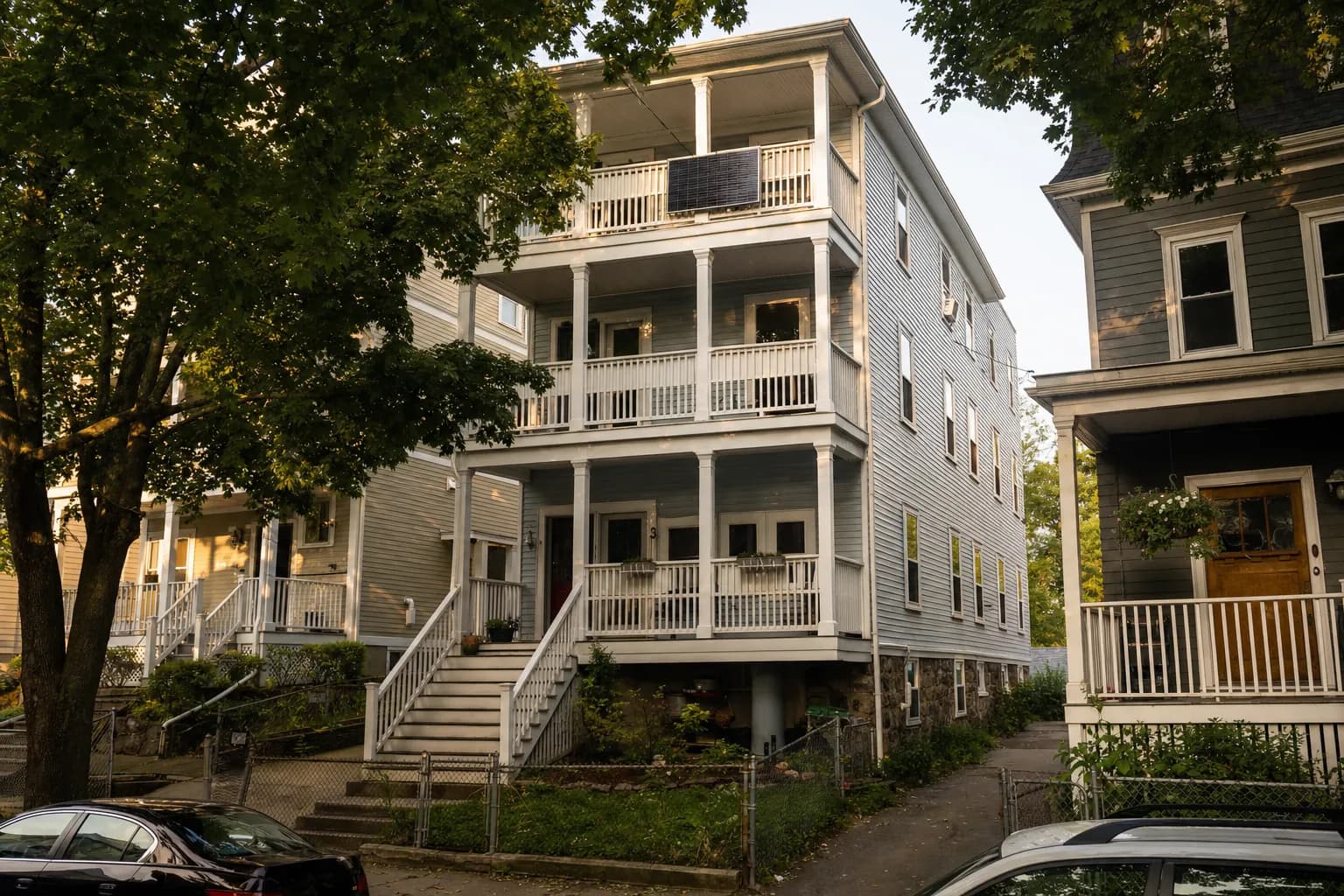
What New Jersey's law says (not yet in effect)
A portable solar generation device is capped at 1,200 watts and plugs into an ordinary 120-volt outlet.
“(1) has a maximum power output of not more than 1,200 watts; (2) is designed to be connected to a building’s electrical system through a standard 120-volt alternating current outlet”
pub.njleg.gov ↗The utility cannot require its approval first, charge a fee, or make you add equipment.
“An electric public utility shall not require a customer using a portable solar generation device to: (1) obtain the electric public utility's prior approval before installing or using the device; … (2) pay any fee or charge related to the device; or (3) install any additional controls or equipment”
pub.njleg.gov ↗No interconnection agreement is needed, and the device sits outside net metering.
“a portable solar generation device shall be exempt from: (1) any requirement to obtain or execute an interconnection agreement prior to operating the portable solar generation device … and (2) net metering program requirements”
pub.njleg.gov ↗A town cannot ban the device on residential property or require a permit for it.
“a municipality shall not prohibit the use of a portable solar generation device on a residential property. … No municipality shall require a permit, application, fee, license, or other approval for the placement or use of a portable solar generation device.”
pub.njleg.gov ↗A landlord cannot ban it, including on a leased balcony or patio, but may set reasonable rules on size and placement.
“No landlord shall prohibit a tenant … from utilizing a portable solar generation device or placing a portable solar generation device … the tenant’s leased premises … including any leased balcony or patio … A landlord may establish reasonable restrictions concerning the physical dimension, placement,”
pub.njleg.gov ↗The act sets no calendar start date. It begins six months after enactment, and the Governor signed it on September 1, 2026. We have found no official page printing the date, so our record leaves it blank.
“This act shall take effect six months after the date of enactment, except that the board may take any anticipatory action in advance of the effective date as is necessary for the implementation of this act.”
pub.njleg.gov ↗
What New Jersey's largest utilities say
What each utility's own tariff or interconnection page says about generation a customer connects on their side of the meter.
PSE&G
PSE&G routes solar through a signed net metering or interconnection agreement, then permission before switching on. The page does not mention plug-in or portable solar.
“You or your renewable energy contractor will need to complete a net metering or interconnection agreement, as applicable. If the contractor completes the application, you, as the customer, must still sign the agreement.”
nj.pseg.com ↗JCP&L (FirstEnergy)
JCP&L routes residential systems up to 10 kW through a Level 1 application and says generation must not be energized before it grants Approval to Operate. The page does not mention plug-in or portable solar.
“Note: Generation interconnection should not be energized prior to an electrical inspection and receipt of Approval to Operate by the Company.”
firstenergycorp.com ↗
Who to ask
- New Jersey Board of Public Utilities, Division of Customer Assistance ↗
Takes complaints and questions from utility customers, once you have tried the utility first.
Sources read and quotes checked 2026-09-22.
What an 800 W kit makes in New Jersey
A railing-mounted panel hangs close to vertical, so it makes less than a tilted rooftop panel. These figures use a vertical panel on purpose.
Yearly output
759
kWh / year
800W, south-facing railing, no shade
Electricity rate
23.62
¢ / kWh
EIA, 2025-07 to 2026-06
Yearly savings
$143
per year, before kit cost
assumes 80% self-use
Sun
4.82
peak sun hours / day
optimal tilt, Newark
Output is modeled at Newark with PVGIS 5.3, European Commission Joint Research Centre, ERA5 weather data.
Kits sold in the US
These kits are sold in the US. We rank them on published specs, certification and price and have not tested them. New Jersey's law isn't in effect yet. New Jersey's law covers systems up to 1,200 W, so check the kit's output against that.
Some links in this section are affiliate links. We earn a commission if you buy through them, at no extra cost to you.
Lowest cost per watt
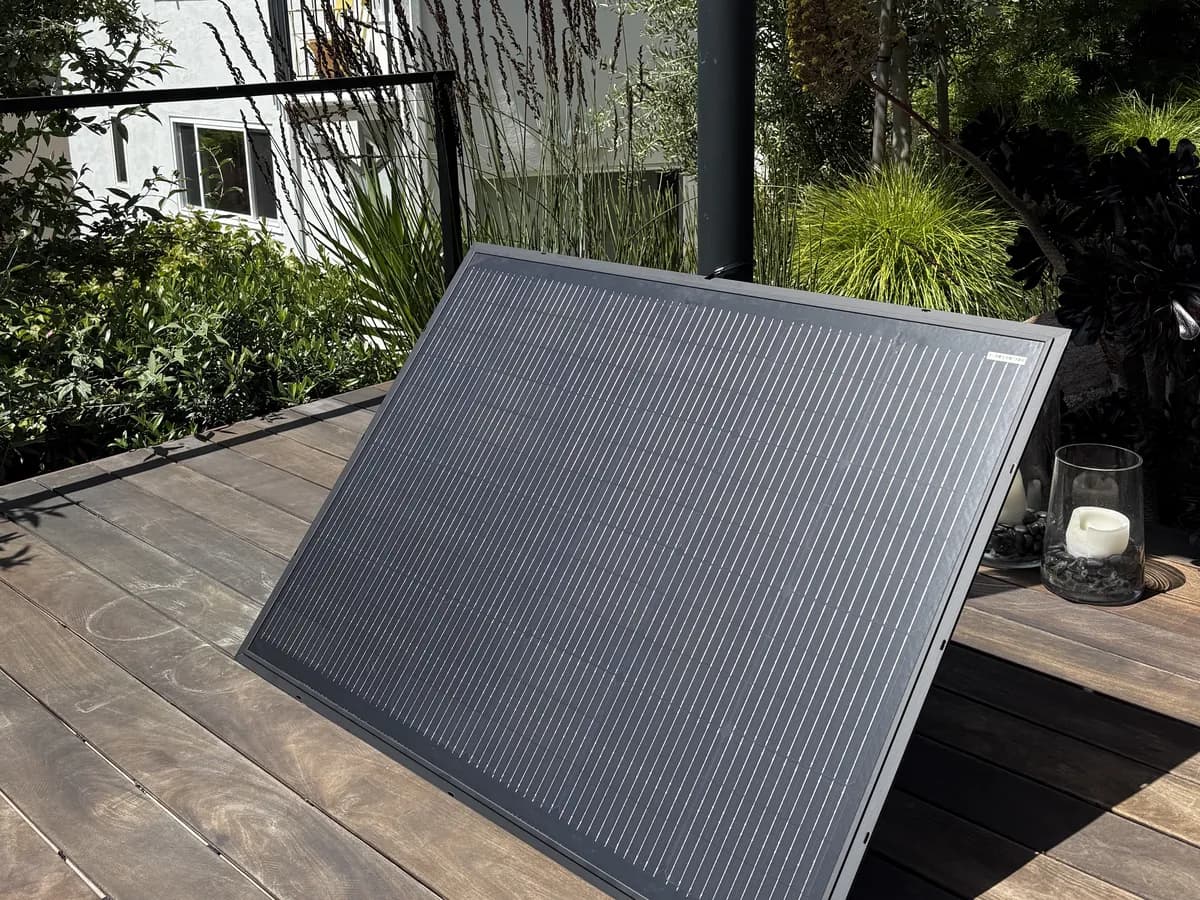
Bright Saver Balcony 360 W
360 W
Two panels and a 360 W microinverter, sold at cost by a nonprofit. The cheapest way into plug-in solar we can find, and the only kit here whose inverter is described against UL 3700.
- Panels
- Two 180 W panels, 46 × 34 in, 11 lb each
- Certification
- Inverter listed as “UL 3700 compliant” (Hoymiles HiFlow Pro LV)
- Warranty
- 12-year inverter warranty
- Price
- $414.17 as of 2026-09-22
At-cost price from a 501(c)(3) nonprofit, not a retail price.
Bright Saver is a nonprofit we cover editorially. We earn nothing from this link.
Built-in battery
EcoFlow STREAM Ultra
800 W
800 W of on-grid output with 1.92–11.52 kWh of storage, so power made in the afternoon can run the evening. Pairing it with the STREAM Microinverter raises output to 1,200 W.
- Panels
- Not included
- Certification
- “UL1741-Certified & IEEE1547-Certified”
- Warranty
- 10 years
- Price
- Not published
EcoFlow lists no price until you configure the system.
Panels are not included, and EcoFlow's own page says plug-and-play use is currently available only in Utah, under H.B. 340.
Complete kit on Amazon
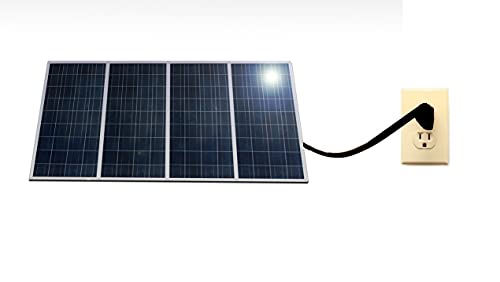
PluggedSolar 800 W Plug and Play
800 W
A complete kit sold as one box on Amazon. The panels sit in the sun and the cord goes to an outlet, so nothing is hard-wired.
- Panels
- Four 200 W panels, with a microinverter and a 50 ft cord
- Certification
- “UL 1741 code compliant for anti-islanding safety protection” (pluggedsolar.com); no lab listing published
- Warranty
- Not published
- Price
- $1,395.00 as of 2026-09-22
Amazon price read through the Creators API.
PluggedSolar publishes no lab listing for this kit and no warranty term we could find. Its Amazon listing estimates 1,500 kWh a year, which assumes panels angled at the sun.
We earn a commission if you buy through this link. It costs you nothing extra.
Most power
Craftstrom 1200 W Plug-in Solar Kit
1,200 W
Six panels and three 350 W microinverters with a smart power meter, for a yard, fence or long deck. The most output of anything here, at the highest price per watt.
- Panels
- Six 200 W bifacial semi-flexible panels
- Certification
- Inverters “ETL-certified to UL 1741 and IEEE 1547”
- Warranty
- 10 years on panels, inverters and power meter
- Price
- $3,309.00 as of 2026-09-22
Listed by the reseller My Own Watts.
Craftstrom sells through dealers, so prices differ by seller. We have no affiliate relationship with any of them.
- Anker SOLIX sells balcony systems in Europe, not in the US. We'll add them when a US model ships.
Questions about New Jersey
Is plug-in solar legal in New Jersey?
New Jersey has passed S2368 / A4836 allowing plug-in solar, but we haven't confirmed its effective date on an official source yet. The limit is 1,200 watts.
Do I need a permit for plug-in solar in New Jersey?
No, according to the law cited on this page.
Is there a wattage limit in New Jersey?
Yes. New Jersey's law covers systems up to 1,200 watts.
How much could an 800W kit save in New Jersey?
About $143 a year, before the kit's cost, for an unshaded 800W panel on a south-facing railing at 23.62¢/kWh. That assumes you use 80% of what it makes. Run the calculator for your own numbers.