Is plug-in solar legal in California? (2026)
Not yet. California has no law allowing plug-in solar, but SB 868 would create one. Here is where it stands, with the official bill page.
Bill pending
California's plug-in solar bill, SB 868, passed both houses and has been on Governor Newsom's desk since August 31, 2026; it is not law yet.
- Watt cap
- —
- Permit
- —
- Interconnection
- —
- Utility notice
- —
- Equipment
- —
- Law
- —
- Signed
- —
- Effective
- —
Official sources
- leginfo.legislature.ca.govleginfo.legislature.ca.gov/faces/billHistoryClient.xhtml?bill_id=202520260SB868
- leginfo.legislature.ca.govleginfo.legislature.ca.gov/faces/billTextClient.xhtml?bill_id=202520260SB868
Research notes
SB 868 (Wiener), 'Electricity: portable solar generation devices' (Plug and Play Solar Act per author statement). Enrolled text (2026-08-28) would add Pub. Util. Code secs. 8530-8532: device = PV device(s) with max aggregated AC output of no more than 1,200 W per dwelling; connected/disconnected through a receptacle; meets NEC and California Electrical Code; certified as a plug-in PV system by UL or equivalent NRTL; includes a UL/NRTL-certified feature that prevents backfeed during an outage. Qualifying devices exempt from all interconnection requirements (state, CPUC, IOU and POU rules); utility may not require approval, fees, or extra equipment; utility MAY require notice via a simple online registration form (address, make, model, size) that cannot require approval. Exemption section 8531 sunsets 2030-01-01; beginning 2030-01-01, sale of receptacle-connected PV devices that do not meet the NEC/UL/anti-backfeed conditions is prohibited in CA. Covers IOUs and publicly owned utilities. Fields wattCap/interconnection/notice/UL are left null because the bill is not law; the figures above are bill text only. If signed, the effective date is not stated in the bill; as a non-urgency statute it would normally take effect 2027-01-01 (general constitutional rule, not separately verified in this pass). Current law: the Assembly U&E committee analysis (June 2026) states interconnection of customer generation at IOUs is governed by CPUC Electric Rule 21, that IOUs argue Rule 21 requires all behind-the-meter systems to be screened, and that a recent CPUC scoping memo raised whether plug-in devices should be considered under Rule 21; no CPUC decision specific to plug-in devices was located or fetched. Other 2025-26 bill: AB 2612 (Schultz), building standards for qualified plug-in PV systems, was held under submission in Senate Appropriations 2026-08-13 and did not pass before the 2026-08-31 end of session; treated as dead. Recheck after 2026-09-30.
“—” means our record has no sourced value · Not legal advice
If you rent
Without a state law, you need two yeses: your landlord’s, and your utility’s. Start with the utility, because a landlord will ask whether it’s allowed. Ask these three questions and get the answers in writing:
- “Do you have an interconnection requirement for a plug-in solar device under 1,200 watts with a UL-listed inverter?”
- “If it never sends power back to the grid, does that change your answer?”
- “Can you send me that in writing, or point me to the tariff section?”
If you get a written answer, send it to hello@mlighthouse.com. We’ll add it to this page with the utility named and you left out.
If you own your home
You have the same utility question as a renter, and one more option: a conventional rooftop or ground-mount system goes through your utility’s standard interconnection process instead. It costs more and takes longer, but the rules are written down.
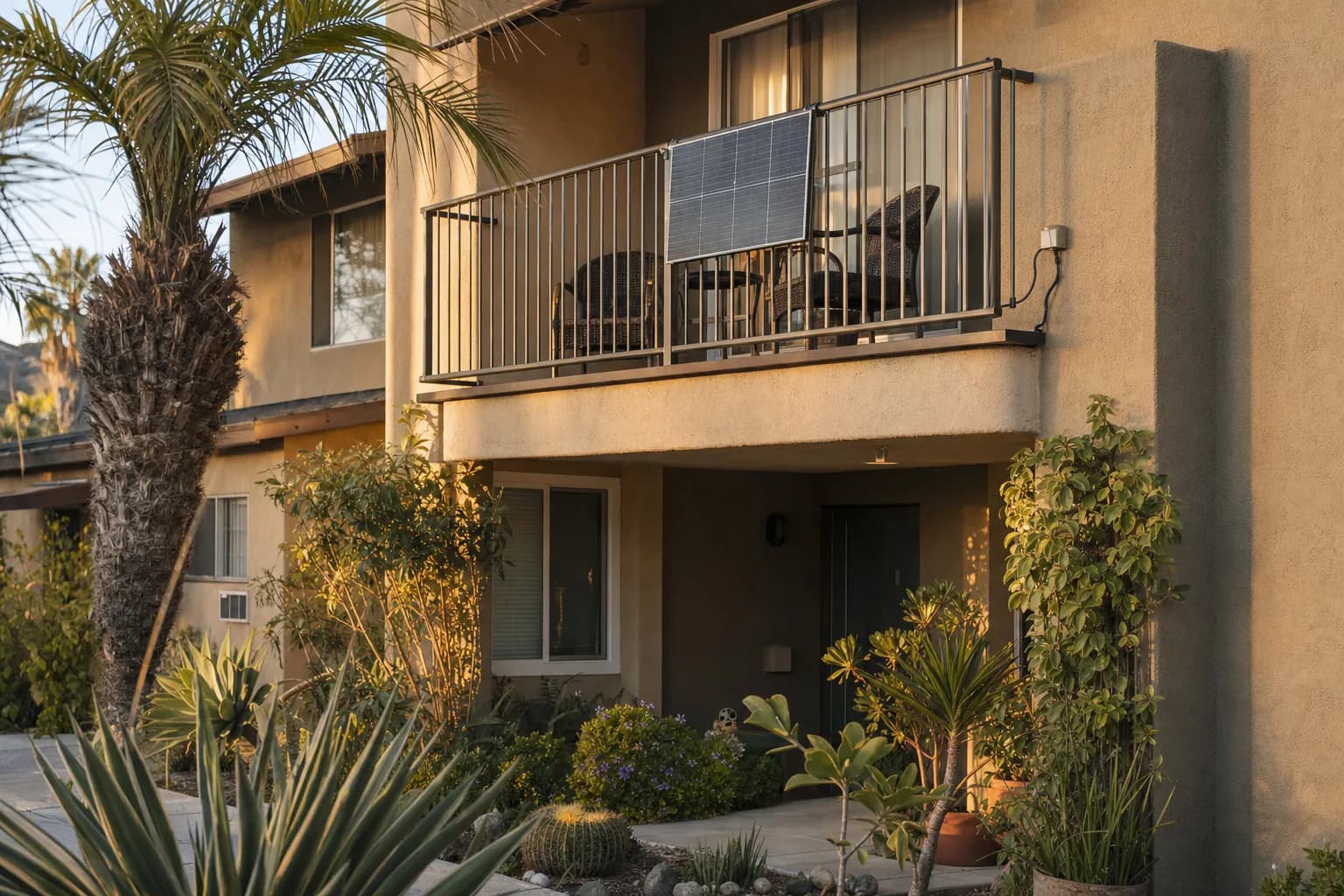
Where the bill stands
SB 868
Passed Senate 35-1 (2026-05-19) and Assembly 73-0 (2026-08-25); Senate concurred in Assembly amendments 36-4 (2026-08-26); enrolled and presented to the Governor 2026-08-31 at 6 p.m. No signature or veto recorded on the official bill history as of 2026-09-20. Governor must act by 2026-09-30 or it becomes law without signature (Cal. Const. art. IV, sec. 10(b)(2)).
leginfo.legislature.ca.govWhat the pending bill would do
The enrolled bill would cap a household's plug-in solar at 1,200 watts of AC output per dwelling.
“Has a maximum aggregated AC output of no more than 1,200 watts per dwelling.”
leginfo.legislature.ca.gov ↗The device would have to be certified as a plug-in PV system by UL or an equivalent lab.
“Is certified as a plug-in photovoltaic system by Underwriters Laboratories, or an equivalent nationally recognized testing laboratory.”
leginfo.legislature.ca.gov ↗Qualifying devices would be exempt from interconnection requirements at both investor-owned and city-owned utilities.
“A portable solar generation device is exempt from all interconnection requirements imposed by state law, the commission, electrical corporation rules, or local publicly owned electric utility rules”
leginfo.legislature.ca.gov ↗A utility could ask for notice through a simple online form with the address, make, model and size, but it couldn't require approval.
“using a simple online registration form, of the address, make, model, and size of the portable solar generation device.”
leginfo.legislature.ca.gov ↗The interconnection exemption would expire on January 1, 2030 unless extended.
“This section shall remain in effect only until January 1, 2030, and as of that date is repealed.”
leginfo.legislature.ca.gov ↗
What California's largest utilities say
What each utility's own tariff or interconnection page says about generation a customer connects on their side of the meter.
Pacific Gas and Electric (PG&E)
In a newsroom post, not a tariff, PG&E says a plug-in device that exports power should follow the existing interconnection requirements.
“If a device exports power to the grid, it should follow established interconnection requirements.”
pge.com ↗Southern California Edison (SCE)
SCE says you may run a solar system only once it issues Permission to Operate. The page does not mention plug-in or portable solar.
“Once your project receives final approval, we will issue your Permission to Operate, which will authorize you to operate your solar generating system.”
sce.com ↗San Diego Gas & Electric
SDG&E routes residential solar and storage through its online interconnection portal. The page does not mention plug-in or portable solar.
“Residential rooftop solar, solar + storage, or stand-alone storage under the Solar Billing Plan program, interconnection is made to SDG&E using the online interconnection portal.”
sdge.com ↗
Who to ask
- California Public Utilities Commission, file a complaint ↗
Takes informal complaints about the utilities it regulates, once you have tried the utility first.
Sources read and quotes checked 2026-09-22.
What an 800 W kit makes in California
A railing-mounted panel hangs close to vertical, so it makes less than a tilted rooftop panel. These figures use a vertical panel on purpose.
Yearly output
852
kWh / year
800W, south-facing railing, no shade
Electricity rate
33.05
¢ / kWh
EIA, 2025-07 to 2026-06
Yearly savings
$225
per year, before kit cost
assumes 80% self-use
Sun
6.41
peak sun hours / day
optimal tilt, Los Angeles
Output is modeled at Los Angeles with PVGIS 5.3, European Commission Joint Research Centre, ERA5 weather data.
Kits sold in the US
These kits are sold in the US. We rank them on published specs, certification and price and have not tested them. California has no plug-in solar law yet, so ask your utility before you connect one.
Some links in this section are affiliate links. We earn a commission if you buy through them, at no extra cost to you.
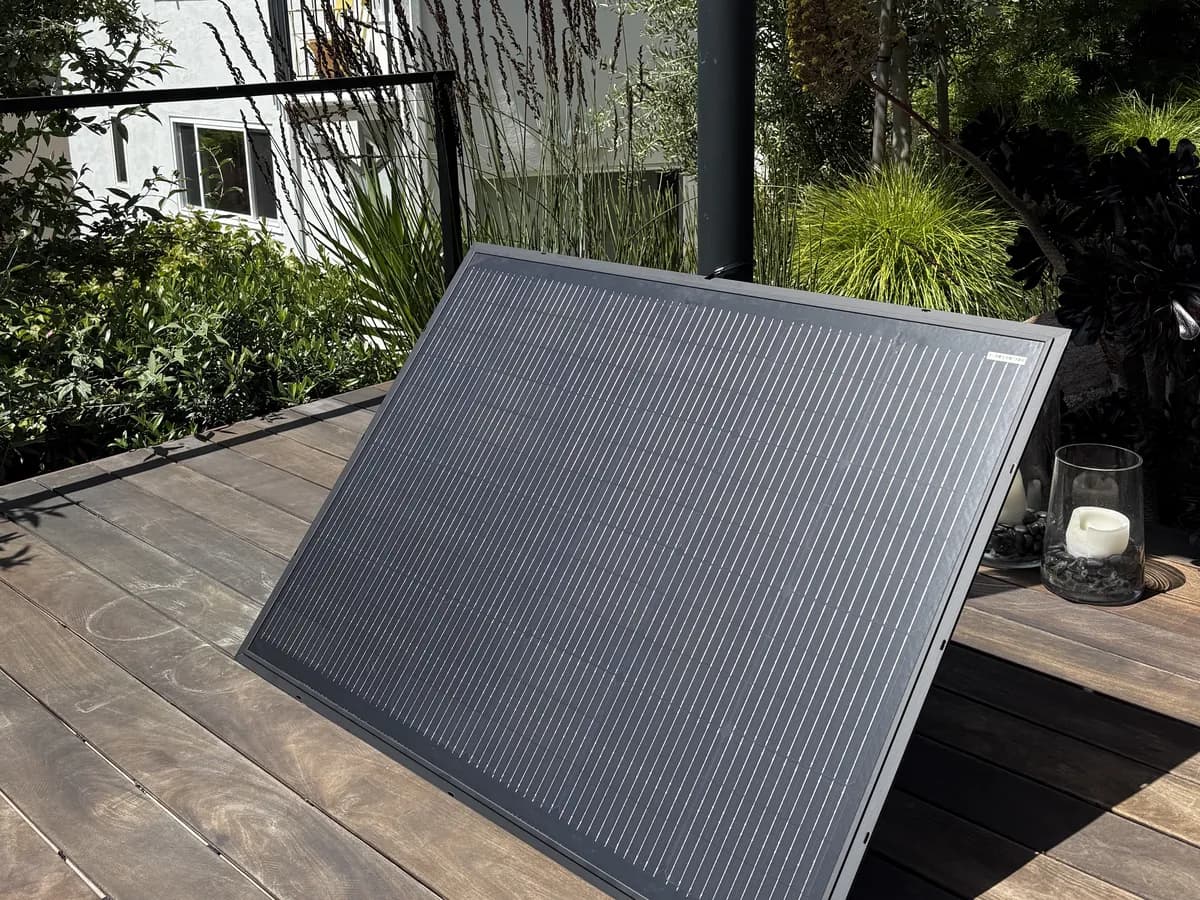
Lowest cost per watt
Bright Saver Balcony 360 W
360 W
Two panels and a 360 W microinverter, sold at cost by a nonprofit. The cheapest way into plug-in solar we can find, and the only kit here whose inverter is described against UL 3700.
- Panels
- Two 180 W panels, 46 × 34 in, 11 lb each
- Certification
- Inverter listed as “UL 3700 compliant” (Hoymiles HiFlow Pro LV)
- Warranty
- 12-year inverter warranty
- Price
- $414.17 as of 2026-09-22
At-cost price from a 501(c)(3) nonprofit, not a retail price.
Bright Saver is a nonprofit we cover editorially. We earn nothing from this link.
Built-in battery
EcoFlow STREAM Ultra
800 W
800 W of on-grid output with 1.92–11.52 kWh of storage, so power made in the afternoon can run the evening. Pairing it with the STREAM Microinverter raises output to 1,200 W.
- Panels
- Not included
- Certification
- “UL1741-Certified & IEEE1547-Certified”
- Warranty
- 10 years
- Price
- Not published
EcoFlow lists no price until you configure the system.
Panels are not included, and EcoFlow's own page says plug-and-play use is currently available only in Utah, under H.B. 340.
Complete kit on Amazon
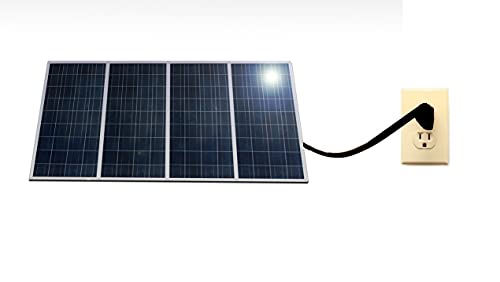
PluggedSolar 800 W Plug and Play
800 W
A complete kit sold as one box on Amazon. The panels sit in the sun and the cord goes to an outlet, so nothing is hard-wired.
- Panels
- Four 200 W panels, with a microinverter and a 50 ft cord
- Certification
- “UL 1741 code compliant for anti-islanding safety protection” (pluggedsolar.com); no lab listing published
- Warranty
- Not published
- Price
- $1,395.00 as of 2026-09-22
Amazon price read through the Creators API.
PluggedSolar publishes no lab listing for this kit and no warranty term we could find. Its Amazon listing estimates 1,500 kWh a year, which assumes panels angled at the sun.
We earn a commission if you buy through this link. It costs you nothing extra.
Most power
Craftstrom 1200 W Plug-in Solar Kit
1,200 W
Six panels and three 350 W microinverters with a smart power meter, for a yard, fence or long deck. The most output of anything here, at the highest price per watt.
- Panels
- Six 200 W bifacial semi-flexible panels
- Certification
- Inverters “ETL-certified to UL 1741 and IEEE 1547”
- Warranty
- 10 years on panels, inverters and power meter
- Price
- $3,309.00 as of 2026-09-22
Listed by the reseller My Own Watts.
Craftstrom sells through dealers, so prices differ by seller. We have no affiliate relationship with any of them.
- Anker SOLIX sells balcony systems in Europe, not in the US. We'll add them when a US model ships.
Questions about California
Is plug-in solar legal in California?
Not yet. California has no law allowing plug-in solar, but SB 868 would create one. Here is where it stands, with the official bill page.
When could plug-in solar become legal in California?
SB 868: Passed Senate 35-1 (2026-05-19) and Assembly 73-0 (2026-08-25); Senate concurred in Assembly amendments 36-4 (2026-08-26); enrolled and presented to the Governor 2026-08-31 at 6 p.m. No signature or veto recorded on the official bill history as of 2026-09-20. Governor must act by 2026-09-30 or it becomes law without signature (Cal. Const. art. IV, sec. 10(b)(2)).
How much could an 800W kit save in California?
About $225 a year, before the kit's cost, for an unshaded 800W panel on a south-facing railing at 33.05¢/kWh. That assumes you use 80% of what it makes. Run the calculator for your own numbers.